About Me

About Me
Click on Pic for More Info

Our Names

Teacher:

Mrs. Ben (Bendixsen)

Paraeducators:


Class Schedule

Monday:

9:50-3:10

Tuesday-Friday

8:50-3:10

Popular Posts

Showing posts with label Summer Reading Program. Show all posts

Monday, August 11, 2014

Alphabet Hunt


Let's go on an Alphabet Hunt! What you need is a magnifying glass and some books. If you don't have a magnifying glass, you can use a ring from the lid of a mason jar. I recommend one of the following (LMNO Peas for developmentally younger kiddos and Don't Let the Pigeon Drive the Bus for the older Kiddos):

LMNO Peas
Written and Illustrated by Keith Baker
Beach Lane Books, 2010

Don't Let the Pigeon Drive the Bus
Written and Illustrated by Mo Williams
Hyperion Press, 2003
Decide what letter you want to look for. You can even have a 'match card' where you write down the letter to look for. For older kids it'd be a great way to teach correspondence between lowercase and uppercase letters. Search for the letter on each page. For younger kids it may be a hunt all over the page, for older kids, follow the sentences as if reading. For our kids that are really ready for it, add a simple word to that word card, like 'the'.

Wednesday, August 6, 2014

Swimmy


Swimmy
Written by Leo Lionni
Dragonfly Books, (Reissued Ed.) 1973


Swimmy is a Caldecott Honor Book about a a fish full of bravery and ingenuity who uses teamwork to help a school of fish overcome their fears in the deep dark ocean. 

Create a 'Gel Aquarium' following the directions from www.teachpreschool.org to make a colorful sensory bag. Use blue and green food coloring for a 'sea water' look. Add fishes to your aquarium. Use a carton (like from milk or juice) to draw on fish and cut them out. If you want to add designs on your fish, use a non-washable marker so it doesn't bleed in the aquarium  
You can also do a Sponge Painting by cutting a sponge into a shape of a fish (or you can probably find them at the dollar store) making designs with all the little fishes.


Wednesday, July 30, 2014

Mrs. Wishy-Washy


Mrs. Wishy-Washy
Written by Joy Cowley and Illustrated by Elizabeth Ann Fuller.
McGraw-Hill, 1980


"Oh, lovely mud, said the duck", 
"Oh look at you!.. In the tub"
"In went the Duck, wishy-washy, wishy-washy"

A great book for repetitive vocabulary, especially with our younger ones. Fill the sink with warm soapy water (or the bathtub) and re-enact the book with washable toys from around the house. If they're in the bathtub, you can read the book to them from a safe distance as they follow along with the toys. When it's time to do dishes, you can do an extender: "In goes the bowl, wishy-washy, wishy-washy", "In goes the spoon, wishy-washy, wishy-washy".

Tuesday, July 22, 2014

Crankenstein and Dealing with Emotions


Crankenstein
Written by Samantha Berger and Illustrated by Dan Santat
Little, Brown Books for Young Readers, 2014


Crankenstein just feels cranky! Especially when nothing seems to be going his way. This is one loved by the students in our class. Humorous and relate-able, it catches their attention and brings up a great conversation about dealing with our feelings.

Other books for teaching emotional awareness (and maybe even better at it) include: 
The Way I Feel by Janan Cain
The Way I Feel Books by Albert Whitman
Today I Feel Silly: and other Moods that make my Day by Jaime Lee Curtis
When Sophie Gets Angry, Really Really Angry by Molly Bang
Here's a link to a few more http://www.babble.com/
I went to a conference in Seattle at the Talaris Learning institute on helping on children develop high EQs (Emotional Quotient), which effects them in every other area of development including language and cognitive (academics).  The higher you child's EQ, the higher quality of life they will have.

Although the habits of creating a healthier emotional environment may take some time to create, the steps are simple.

1.  Be Aware of Emotions
Recognize that they are natural, important and learn to read your child's.

2. Connect with Your Child
Try not to dismiss or ignore emotions but use them as a teaching time and a time to talk through them, catching them before the esculate

3. Listen to Your Child
Take your child's emotions seriously, not criticizing them for feeling them, empathize but showing you understand them.

4. Name Emotions
Name them when you feel them, when you recognize how they're feeling and naming all types, whether it's happy, sad, angry etc. Naming emotions soothes a child who is upset.

5. Find Good Solutions
It's okay for a child to be sad or angry but that doesn't mean they should 'get their way or that you can always make the problem go away. Find a solution.

For example, for a younger child:
You're sad. You want the slide but it's time to go. I'll hold you instead (if they like to be held).

For example, for an older child:
I see that you are sad. You want to keep playing but we need to go. It's okay to be upset but we still have to leave. What is something fun we can do when we get home?

Really, you're teaching them, it's okay to feel this way but you still can't get want you want/need. Sometimes it's because they can be sad about something but if you told them 'no', stick with it. Somethings can't be changed. 'Your sad that you left your toy on the plane but we can't get it back'.

For more information, visit: www.parentingcounts.org


Saturday, July 19, 2014

You Are a Lion


You Are a Lion
And Other Fun Yoga Poses
Written by Taeeun Yoo
Nancy Paulsen Books, 2012


A great place to be on a hot summers afternoon just might be in the shade under a great big oak tree or in your darkened, air-conditioned living room listening to classical music as you strive to calm down the kids. This might be a good book for actually making that happen. Full of animal yoga poses, this book is both healthy for the body and fun. Did you know that Yoga is beneficial for kids? First, it teaches them healthy breathing patterns and secondly, it teaches them body awareness (if you're familiar with sensory processing in children, you'll know this calms them down as well. Hooray!) For a easy-to-read handout on this, try this link (click here)

Activity: Read through the book together (yes darken those drapes and turn on that music). Have fun posing like the different animals in the book and practice breathing, counting 1-10. Have them do the counting with you. Then let them decide different animals you can pose like. Have fun either relaxing in the few minutes of peace you might have or giggling as you try and mimic each other and the animals in the book. 

Wednesday, July 9, 2014

I Ain't Gonna Paint


I Ain't Gonna Paint No More
Written by Karen Beaumont and Illustrated by David Catrow
HMH Books for Young Readers, 2005

A fun about rhyming (great for phonemic awareness that contributes to early reading), colors, creativity and body parts!. The grammar may not be the best model for our kiddos but the rest of the book makes up for it, making a fun, engaging and delightful book.

You can read the book while your child follows along painting in the bathtub. Here are some bathtub friendly paint recipes. They call for food coloring, but to insure 'washability' if you have washable paints, I would encourage you to substitute them in for the food coloring.


Bathtub Paint Recipe 1:
1/2 Cup of Cornstarch
1/2 Cup of Water
1 Cup of Dish or Hand Soap
Dye/food coloring

Bathtub Paint Recipe 2:
Can of shaving cream
Food coloring
Muffin Tin to mix them in

Bathtub Paint Recipe 3:
1 tbl cornstarch
4-6 pumps of baby shampoo
2-3 drops food coloring
1-2 tsp water

Monday, June 30, 2014

Round is a Mooncake


Round is a Mooncake
Written by Roseanne Thong and Illustrated by Grace Lin
Chronicle Books, 2000


A book about finding shapes in the world around you. This little girl with a Chinese Heritage finds them in her round mooncake, square name chop, rectangle abacus and the round lanterns around her. 

Take a shape hunting walk around the house, the backyard, at grandma's house or somewhere else fun like the playground. How many can you find? How are they the same or different including colors, sizes, dimensions? You could even cut out paper shapes and write the names on each one, using them to 'match' shapes for kids that might not yet distinguish between each of the shapes. Want to make it challenging? Don't forget the more difficult shapes from rectangles and ovals to maybe even trapezoids

As you read the story, talk about what might be culturally significant to this girl and her family. What are some traditions and items you have in your home that might be different or unique to someone else?

Monday, June 23, 2014

It Looked Like Spilt Milk


It Looked Like Spilt Milk
Written and Illustrated by Charles Shaw.
Scholastic, 1988


A great book for vocabulary and discussion. The simple pictures show an object on each page making the reader think about whether or not it's just 'spilt milk'.

Activity: Spill some milk. Give your child(ren) a straw and see if he or she can blow it into different shapes and guess what they make. This can also be done to make a permanent picture with thinned (water-downed) white paint on dark paper. Blowing with the straw is also great for oral-motor development.

Do some sky-gazing. Lay outside under the clouds and guess what each of the shapes could be. If your child has an active imagination, encourage stories to evolve with these new characters.


Monday, June 16, 2014

One Duck Stuck


One Duck Stuck
Written by Phyllis Root, Illustrated by Jane Chapman
Candlewick Press, 1998

"Five Frogs plop to the Duck. No luck, still stuck".

It's time to get dirty. Start with a tub of mud. If you don't want to get too dirty or for a little more fun, a tub of chocolate pudding works great.
Start by reading the book together and then 'making' your own mud, measuring out the ingredients (whether it be dirt and water or pudding mix and milk). Mix together. Use toys from the house to re-enact the story. "Two fish, tails going swish, swim to the duck. No luck, duck stays stuck, deep in the muck, down by the fishy, squishy marsh."

Encourage using the phrases "Help, help, who can help?"

Through out the week, when you need help (like cleaning up toys) you can encourage them to help but saying, "Help, help, who can help?"


Summer Time


I've been putting together some of our summer reading program posts. I really wanted to share this book and I couldn't decide what activities would go along well with it. Mostly I just want to say, go on a picnic! Talk about the things you like to do in the summer. Plan out an activity to do as a family that's best in the summer. So there it is.

It also made me think of this article posted on KSL. It might be worth a read. We live in a culture with high exceptions and it's good to keep a realistic perspective in mind. So, that being said, enjoy the article and most of all, enjoy spending time with your kids: A Realistic Summer Bucket List (Link)

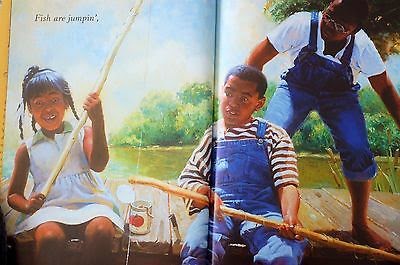
Summertime
Written by Dubose and Dorothy Heyward, Paintings by Mike Wimmer
Aladdin, 1999


Summertime,
And the livin' is easy
Fish are jumpin'
And the cotton is high

Your daddy's rich
And your mamma's good lookin'
So hush little baby
Don't you cry

One of these mornings
You're going to rise up singing
Then you'll spread your wings
And you'll take to the sky

But till that morning
There's a'nothing can harm you
With daddy and mamma standing by


Monday, June 9, 2014

Mouse Paint

Mouse Paint
Written by Ellen Stoll Walsh
Harcourt, 1995


Mouse Paint is a very simply written story about 3 white mice who come upon 3 containers of primary colored paints. Upon experimenting, each mouse becomes different colors. It's a great book for learning what primary colors make which secondary colors. It's also great for encouraging children to do some experimenting for themselves.

Color Mixing: Try one the activities starting with the primary colors, red, yellow and blue.

Playdough:
Softest Playdough~ 1 part hair conditioner, 2 parts cornstarch 
Edible Playdough~ 1 Tub Whip Topping, 1/2 Box of cornstarch, 2 Tbl of Olive Oil

Shaving Cream: Shaving Cream, Elmer's Glue and Paint (avoid the mess? Put on paper plates and then in gallon-sized ziplock baggies. Seal and finger-paint through the plastic).

Ice Cubes: Color different tray sections with each of the primary colors (food coloring and water) and then freeze. Take them out and stick them in glass cups, trying different colors together to see what they become when melted.

You can also do this activity we did as a class: Star Shooters

Friday, May 30, 2014

The Very Hungry Caterpillar


The Very Hungry Caterpillar
Written and Illustrated by Eric Carle,
Putnam, 1969

The Very Hungry Caterpillar has been described as, "One of the greatest childhood classics of our time".* We read it as a class and did many large and small group activities and the student's loved it. This may be a good one to do at the of beginning of summer, since most of the students already are familiar with it and enjoy it immensely.

Read the book together, even if it's just summarizing for our developmentally younger students. Many concepts are great for emphasizing including counting, sequencing, labeling foods, labeling colors and allowing students to 'read' and re-tell it back in their own way.

Activity: There are many activities you can do with this book. Feel free to do some we did this last year as a class (click here, here and here), looking at the small group lesson plans.

Here is another one you can do. Collect the grocery advertisements that come in the mail. Cut out the different foods. You can take an pringles can or another similar cylinder, decorate it like a caterpillar and feed the food to it, counting and telling the 'story' as you go. 
Or
Make a giant caterpillar out of paper plates. Glue the foods on to each plate. Tell the story as you lay out each plate for each thing the caterpillar ate and watch it grow.


*Kate Taylor (22 October 2004). Eat Your Heart Out. The Guardian

Thursday, May 1, 2014

Preschool Summer Reading Program


“Reading to your child may be the single, most powerful contribution that you,
 as a parent, can make toward their success in school.”
-William Russell

Summer is on it’s way! I am putting together activities that you can do with your child throughout the summer to encourage skills to prepare them for the fall.  These skills include book knowledge concepts, phonological awareness, alphabetic knowledge, concepts in relation to math and science, vocabulary, language and continuing to increase attending skills. However, don’t worry. They will be naturally embedded into the book and the activities and fun! Most importantly, they will provide an opportunity for you to be with your child as they continue to learn and grow.

Throughout the summer I will post activities and a corresponding book
that you can find at the library or may already own. Many of these books you can also find on youtube. For some of you that may have trouble getting your child to sit still through an entire story, create a routine, for example, at night to settle down before bed, or even while they’re in the bathtub. That’s the way I get through a one at our house. 

Enjoy your summer!


Here’s a kick off one even though we still have a month of school left:

Eric Carle's Brown Bear, Brown Bear What Do You See and Activities

Brown Bear, Brown Bear -SRP


Brown Bear, Brown Bear, What Do You See?
Written by Bill Martin Jr., Illustrated by Eric Carle,
Henry Holt & Company 1983


Brown Bear, Brown Bear, What do you see?
I see a Red Bird looking at Me.

Red Bird, Red Bird, What do you see?
I see a Yellow Duck looking at Me.

Yellow Duck, Yellow Duck, do you see?
I see a Blue Horse looking at Me.

Blue Horse, Blue Horse, What do you see?
I see a Green Frog looking at Me.

Green Frog, Green Frog, What do you see?
I see a Purple Cat looking at Me.

Purple Cat, Purple Cat, What do you see?
I see a White Dog looking at Me.

White Dog, White Dog, What do you see?
I see a Black Sheep looking at Me.

Black Sheep, Black Sheep, What do you see?
I see a Goldfish looking at Me.

Goldfish, Goldfish, What do you see?
I see a Teacher looking at Me.

Teacher, Teacher, What do you see?
I see Children looking at Me.


Children, Children, What do you see?
We see a Brown Bear, a Red Bird, a Yellow Duck, a Blue Horse, a Green Frog, a Purple Cat, a White Dog, a Black Sheep, a Gold Fish and a Teacher looking at us, that’s what we see.

Developmental Focus: Colors and Animal Names, “Wh” questions, Predicting, Concepts of Print


Activities: 
Read the story, predict what is coming next. Once they get the pattern of text down on each page, have them "read" it or fill in the blanks.

Listen to the song (http://youtu.be/ek7j3huAApc) and sign color and/or animal names.

Write or tell your own story: For example, we have done: Snowman, snowman, what do you wear? I wear a black hat on my head, Snowman, snowman, what do you wear? I wear a purple scarf around my neck etc… You can do different animals, foods, characters etc.

Make popsicle (or tongue depressor) puppets with the animals on them to hold up when they each one is read in the story.

Here are more activity ideas: Click Herehowever, remember that simplicity is better, especially when your child is younger and you also want to choose activities that allow your child to self-direct and discover as they go along.